Smart Textile Wearables for DVT Detection
ThrombUS+ partner ComfTech srl exhibited at MEDICA 2026, the international medical trade fair held in Düsseldorf from 16 to 19 November, presenting the project and the smart textile technology behind the ThrombUS+ wearable.
Textiles for Continuous DVT monitoring
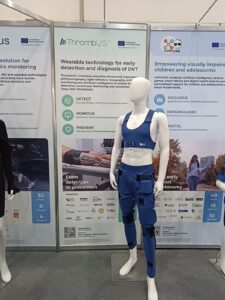
ThrombUS+ is developing a wearable system for the continuous, autonomous early detection of deep vein thrombosis (DVT). The system combines AI-driven compression ultrasound with electrical impedance plethysmography and light reflection rheography. Reliable monitoring depends on sensors sitting in the right place on the leg every time – which is where smart textiles come in.
The ThrombUS+ wearable is designed in two parts: a strap for compression ultrasound and a smart sock or legging for physiological monitoring. Textile electrodes, strain gauges, and photonic sensors are embedded directly in the garment, which gives standardized sensor placement and reduces the workload for healthcare personnel. The design takes into account different body sizes and clinical conditions such as limb lesions.
Built for hospital use and the circular economy
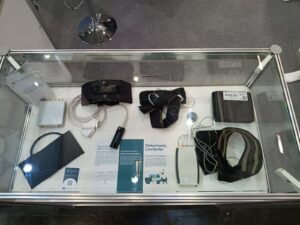
Hospital wearables must be both washable and disinfectable. The ThrombUS+ garments are built so that sensors can be detached, which allows washing and disinfection, replacement of individual components, and recycling at the end of the product’s life. The textiles are made from recycled, long-lasting, and hazard-free materials, in line with the EU Strategy for Sustainable and Circular Textiles.
From prototype to patients
The ThrombUS+ wearable is a prototype under development, and it is being validated through a programme of clinical studies. Trade fairs such as MEDICA give the consortium a chance to present its work to industry, clinicians, and potential adopters, and to gather feedback on the path from prototype to clinical use. Reception so far has been overwhelmingly positive, with multiple participants saying they’d like to be able to purchase the product!
ThrombUS+ is a Horizon Europe project co-funded by the European Union (Grant Agreement No. 101137227).